Reading notes from 2017; technical explanations revised November 17, 2026. Architecture and scale observations refer to the source period.
Separate ingestion from delivery
This talk describes a historical Netflix network-analysis pipeline. Kinesis Data Streams is the stream with shards; Firehose is a managed delivery service. Attributing a shard count directly to Firehose mixes their responsibilities. The original slides should be used for the talk’s actual capacity figures.
A stream retains records for consumers. A delivery service buffers and writes records to a destination. A processing application computes derived results. Storage and dashboards then serve different query and retention requirements. These are separate roles even when several are exposed under related product names.
Trace one flow record
In a conceptual design, a flow record includes source, destination, bytes, and time. Validate its schema, ingest it, aggregate by a bounded time window, then store both raw records and derived metrics if each has a useful retention purpose.
Region and service identity must remain attached to the data. Otherwise a cross-region dashboard may combine measurements that refer to different observation windows or duplicate the same traffic.
Operate the pipeline
Monitor ingestion errors, consumer lag, delivery failures, and the freshness of the displayed result. Retrying a delivery can produce duplicates, so define how aggregation and storage handle them. Do not infer exactly-once behavior from the presence of a managed service.
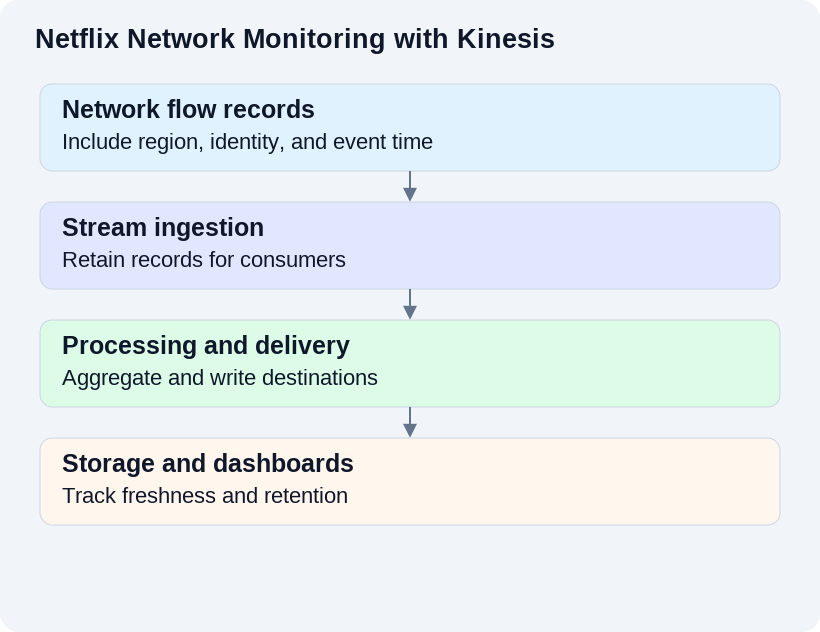
Conceptual illustration; labels describe responsibilities, not a deployment specification.

Source view of service and network dependencies. Historical source figure; attribution and context are in References.

Source network-analysis pipeline; ingestion, delivery, and storage have different roles. Historical source figure; attribution and context are in References.