Reading notes from 2017; technical explanations revised November 17, 2026. Architecture and scale observations refer to the source period.
Separate the device from the analytical system
The historical stack combines device software, data ingestion, distributed storage, and Spark processing. Apache Mynewt concerns constrained-device software; Ignite concerns distributed data and computation. They solve different parts of the path.
For an illustrative temperature event, the device emits an identity, event time, and reading. An ingestion layer validates and routes it. A store supports lookup or aggregation, while a compute job performs analysis. Delayed connectivity and duplicate delivery need explicit handling before the result becomes useful.
What sharing data means
A Spark/Ignite integration can expose data to Spark computations. That does not make every RDD a universally shared, durable object. Check where data resides, how partitions map, and what happens when either side fails.
Durability, replication, and consistency depend on the selected release and configuration. The 2017 demo is an example to inspect, not a production guarantee. Before adapting it, choose compatible Spark, Scala, and Ignite versions and reproduce a small read/write path.
I would evaluate the system with device reconnects, missing readings, schema changes, and node loss, then measure both query freshness and the cost of retaining raw events.
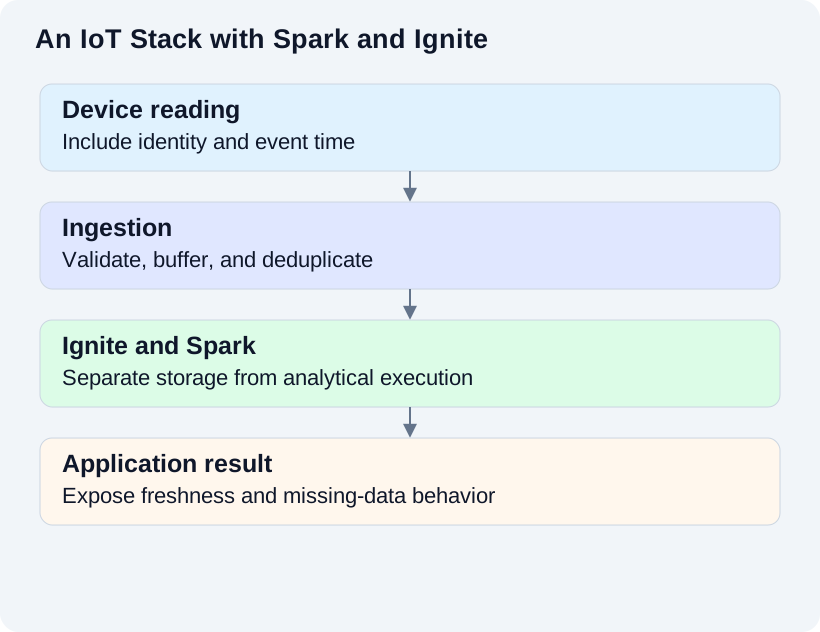
Conceptual illustration; labels describe responsibilities, not a deployment specification.

Source IoT stack places device software, storage, and analytics at different layers. Historical source figure; attribution and context are in References.