Reading notes from 2018; revised November 17, 2026. Reported architecture and scale refer to the source period.
Retrieval followed by regression
The source describes finding similar historical trips and combining their outcomes to make a prediction. Here, ELK refers to the system discussed in the Uber article; it should not be confused with a generic Elasticsearch/Logstash/Kibana logging pipeline.
A conceptual prediction has two stages. First narrow the candidates with hard filters such as city and product. Then rank the remaining trips with a defined similarity function and combine the selected outcomes, for example through a weighted average.
Similarity needs a contract
Distance over raw geographic coordinates, time, and other attributes can be misleading if their scales differ. Specify normalization, missing values, and the meaning of each weight. Choosing the nearest trip is not the same as learning a robust predictor.
Index updates determine which historical observations are available. Calling this online training without explaining the update mechanism confuses data refresh with parameter training. Track observation time, label availability, and index freshness separately.
Evaluate without future information
In an illustrative temporal evaluation, only retrieve trips whose outcomes were available before the query trip. Compare against a simple baseline, measure error by segment, and check sparse regions where very few comparable trips exist. Define fallback behavior before deploying the prediction path.
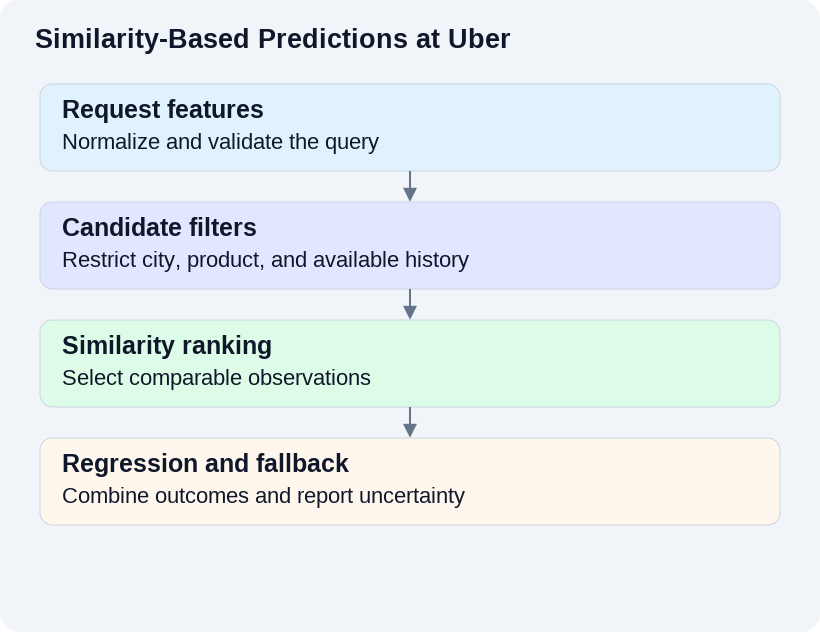
Conceptual illustration; labels describe responsibilities, not a deployment specification.

Uber source architecture for similarity-based prediction. Historical source figure; attribution and context are in References.