Reading notes from 2020; revised November 17, 2026. Reported architecture and scale refer to the source period.
Event-driven workers
NGINX’s master process manages workers and configuration. Workers handle connections through an event loop rather than dedicating one blocking thread to every client. An event indicates that a socket can make progress; the worker performs the relevant work and returns to other connections.
This model does not make blocking work disappear. A slow operation in the worker’s path can still delay other work. Capacity analysis should distinguish active connections, request concurrency, upstream latency, and CPU time.
Reload configuration without discarding all work
A configuration reload starts workers with the new configuration and asks old workers to stop accepting new work and finish existing connections according to shutdown behavior. A binary upgrade replaces the executable and has a different lifecycle. They should not be described as the same operation.
Before reloading a local installation, validate its configuration with nginx -t; use the service manager or documented nginx -s reload command appropriate to that installation. Do not confuse a successful signal with proof that the intended configuration is serving traffic.
A small verification loop
For an illustrative proxy change, make a baseline request, validate the config, reload, then verify the expected response and error logs. Also test an ongoing connection if graceful behavior matters to the application. A health check that opens a new connection will not establish what happened to existing sessions.
The source infographics are useful for process and request-flow context. Their captions should be read with the original NGINX account, not as universal behavior for every module and version.
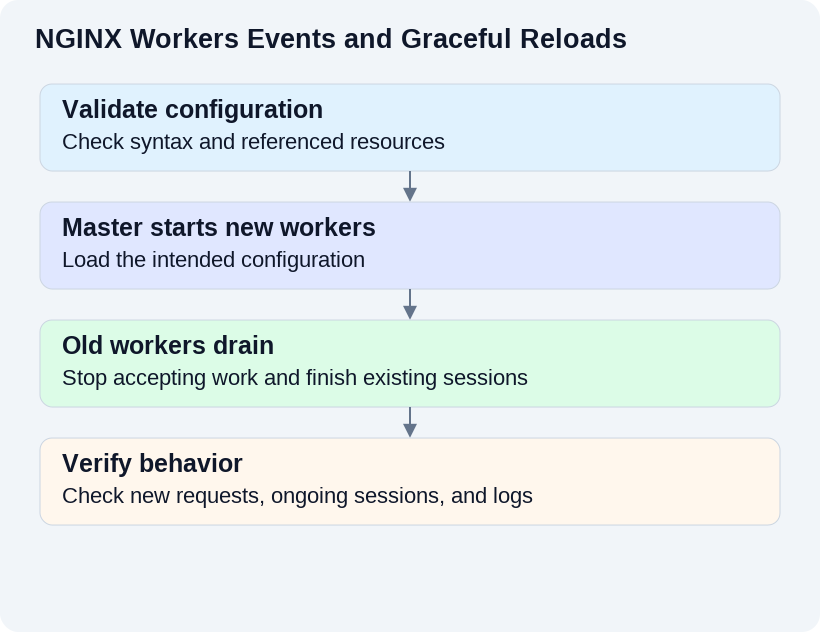
Conceptual illustration; labels describe responsibilities, not a deployment specification.

NGINX source architecture separates the master and worker processes. Historical source figure; attribution and context are in References.

NGINX source worker-process illustration for event-driven connection handling. Historical source figure; attribution and context are in References.