Reading notes from 2021; revised November 17, 2026. Reported architecture and scale refer to the source period.
A lakehouse is not just a warehouse wrapper
The referenced paper argues for combining open data-lake storage with capabilities needed for reliable analytical workloads. The important boundaries are data files, table metadata and transactions, and the engines that read them. A cache or index alone does not explain the architecture.
| Design concern | Question to answer |
|---|---|
| Table state | Which files belong to a committed snapshot? |
| Concurrent changes | How do readers avoid partially written updates? |
| Execution | Which engines can read the table and apply optimizations? |
| Governance | Who can discover and access the data? |
| Performance | Which workload and maintenance costs were measured? |
Consider an update during a long query
A reader should see a defined table state while another job writes an update. Metadata and commit rules determine that view. Rewriting files without a commit protocol can expose inconsistent results even if the storage system reliably retains every object.
For an ML workload, reproducibility adds another question: can the training run identify the exact table snapshot it consumed? A table format helps record state, but the experiment still needs to record that identity.
Compare on an actual workload
The paper’s proposed benefits should be read with its assumptions and evaluations. For a particular domain, compare ingestion, updates, query latency, concurrency, governance, and operating effort. A custom design may optimize one path while losing useful interoperability.
See ML lifecycle tooling for where table formats fit relative to orchestration and model management.
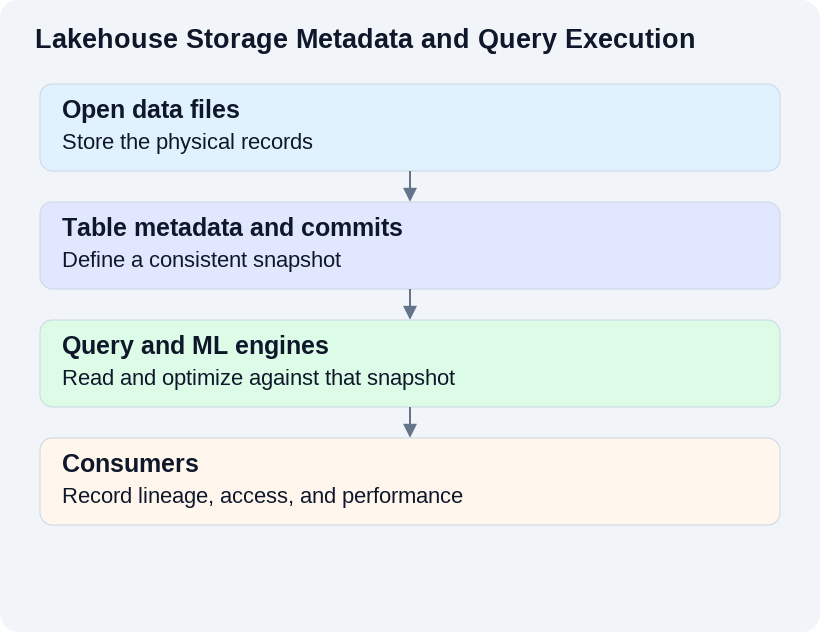
Conceptual illustration; labels describe responsibilities, not a deployment specification.

Architecture comparison from the lakehouse paper. Historical source figure; attribution and context are in References.

A second source comparison illustrating the paper’s data-platform argument. Historical source figure; attribution and context are in References.