Reading notes from 2023; revised November 17, 2026. Reported architecture and scale refer to the source period.
Reduce candidates before expensive scoring
The talk describes people search as staged retrieval and ranking. A query can contain names, organizations, locations, and titles. Tagging and normalization help candidate retrieval interpret those fields rather than treating the input as one undifferentiated string.
For an illustrative query such as “Chris engineer at Acme,” identify possible entities, generate candidates, score relevance, and then personalize or rerank a smaller set. Each stage trades recall against compute and latency.
Separate online scoring from offline preparation
Models and some features can be trained or precomputed offline. That does not make request-time ranking itself offline. Candidate scoring on the query path must fit the online budget. The original L1 label blurred those responsibilities.
The talk’s member count and candidate-reduction figures belong to its presentation date. Use them to understand its scale, not to claim current capacity.
Evaluate every stage
A reranker cannot recover a relevant person that retrieval never selected. Measure retrieval recall separately from ranking quality. Click-derived labels need a definition of meaningful engagement and awareness that position affects what people click.
For a design review, I would ask which features are available at request time, which depend on delayed events, and how missing features affect ranking. Record model and feature versions so an unexpected search result can be investigated.
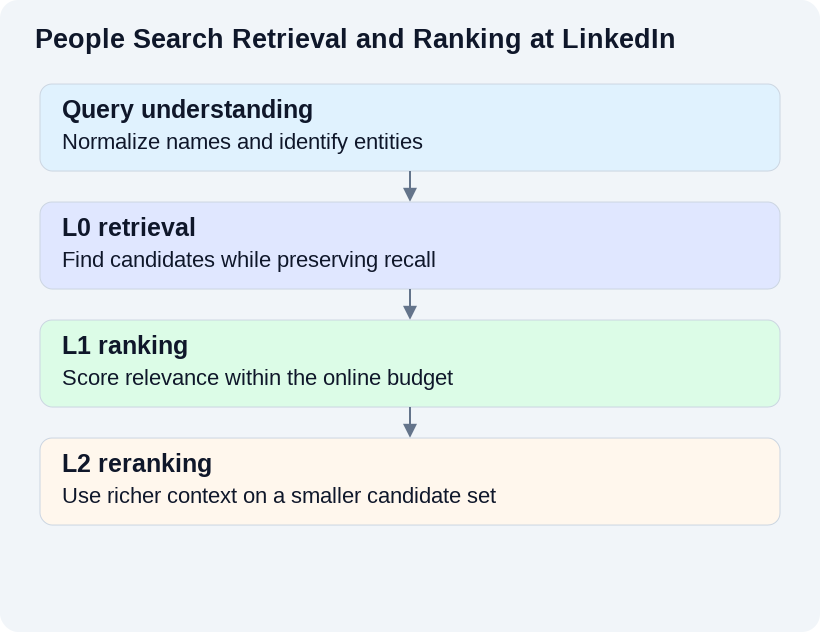
Conceptual illustration; labels describe responsibilities, not a deployment specification.