DeepSeek’s public releases span model weights and systems software. Keeping those categories separate makes their contributions easier to evaluate than treating every repository as one deployable stack.
Models and distilled checkpoints
DeepSeek-V3 is a mixture-of-experts model. DeepSeek-R1 adds a reasoning-focused training account, and the R1 release includes distilled Qwen- and Llama-based checkpoints. Those smaller checkpoints have explicit names and architectures; there is no reason to substitute an unverified deepseek-r1-small classifier identifier. R1 model inventory.
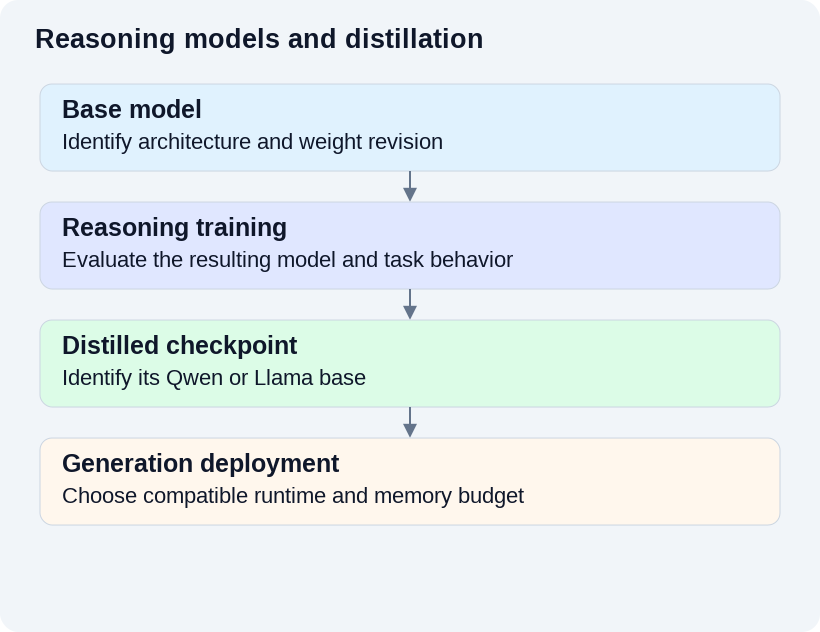
Conceptual illustration; labels describe responsibilities, not a deployment specification.
A generation example with an actual checkpoint
The following is an inference example for deepseek-ai/DeepSeek-R1-Distill-Qwen-1.5B, using Python 3.12, transformers==4.48.3, and torch==2.6.0. It downloads model weights and needs memory for weights plus runtime allocations; it was syntax-checked, not executed on model hardware during this revision.
import torch
from transformers import AutoModelForCausalLM, AutoTokenizer

model_id = "deepseek-ai/DeepSeek-R1-Distill-Qwen-1.5B"
tokenizer = AutoTokenizer.from_pretrained(model_id)
model = AutoModelForCausalLM.from_pretrained(model_id, torch_dtype=torch.float32)
messages = [{"role": "user", "content": "What is 17 multiplied by 23?"}]
prompt = tokenizer.apply_chat_template(messages, tokenize=False,
                                       add_generation_prompt=True)
inputs = tokenizer(prompt, return_tensors="pt")
with torch.inference_mode():
    generated = model.generate(**inputs, max_new_tokens=256, do_sample=False)
new_tokens = generated[0, inputs["input_ids"].shape[1]:]
print(tokenizer.decode(new_tokens, skip_special_tokens=True))
This is text generation, not a sequence-classification head. Deterministic decoding helps make an example easier to inspect; model quality and reasoning behavior still need evaluation across a task set.
Infrastructure projects have their own contracts
| Project | Role to investigate |
|---|---|
| 3FS | Distributed file-system design and its workload assumptions |
| FlashMLA | Attention kernels and supported hardware/layouts |
| DualPipe | Distributed training pipeline scheduling |
Evaluate each repository’s license, release, hardware requirements, and benchmarks independently. A shared publisher does not establish automatic interoperability.
Read performance numbers with their boundaries
A training-compute figure can cover a specific phase rather than every experiment, preprocessing job, and development run. Compare the same accounting boundary before repeating cost-efficiency claims. Likewise, benchmark results need a named task, model revision, decoding settings, and metric.