Running an LLM in production brings together several systems: application APIs, model artifacts, inference engines, deployment automation, and request scheduling. Netflix’s serving platform offers a useful case study in how these responsibilities meet.
These notes begin with the architecture reported by Netflix and InfoQ, then develop practical design implications. The diagrams are original, simplified illustrations. The examples and review questions are my interpretation, rather than descriptions of additional Netflix internals.
1. Where LLM Inference Fits
Netflix retains its JVM serving layer for routing, features, and pre/post-processing. Small CPU models run locally; GPU requests go to Model Scoring Service (MSS), with Triton and vLLM underneath. LLM applications also have an OpenAI-compatible HTTP entry point. Source: InfoQ.
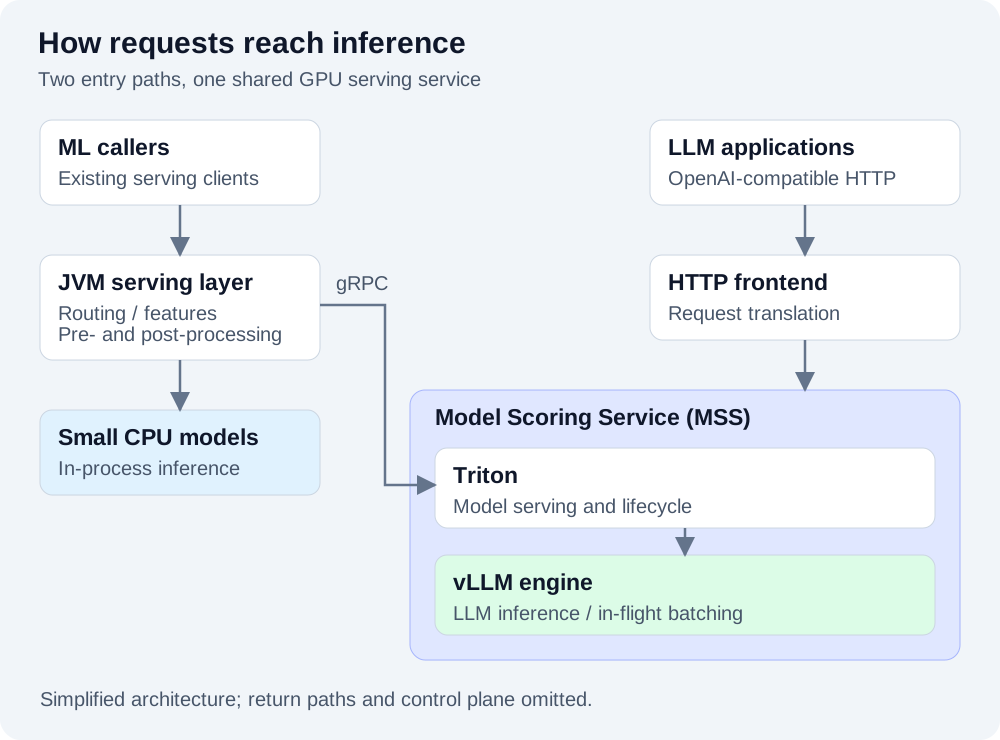
Figure 1. Simplified request paths based on the InfoQ account. Return paths and the control plane are omitted.
For a team extending an existing ML platform, this suggests an ownership question: which responsibilities belong to the application, and which belong to shared infrastructure? Keeping feature retrieval and response transformation outside the inference engine can make those boundaries easier to review. It also gives teams a place to diagnose failures before attributing every slow request to the GPU.
2. What Triton and vLLM Each Contribute
Triton’s general architecture routes requests through per-model schedulers to backends. It provides model management APIs, health endpoints, and serving metrics. Those functions support the operational lifecycle around inference. Source: NVIDIA’s architecture guide.
There is an important detail in the vLLM integration: NVIDIA documents that its backend forwards requests into vLLM’s asynchronous engine, which handles in-flight batching and paged attention. The vLLM backend is itself Python-based; the distinction from a custom Python backend concerns the integration path and the model author’s responsibilities. Source: NVIDIA’s vLLM backend guide.
| Layer | A useful design-review question |
|---|---|
| Application | Who owns feature fetching, business rules, and response interpretation? |
| API frontend | Which request fields survive translation into engine parameters? |
| Model server | How are models loaded, checked, replaced, and removed? |
| Inference engine | How are active requests batched and generation resources managed? |
This separation helps make performance investigations specific. A queueing problem, a failed model load, and expensive per-token computation call for different evidence and different fixes.
3. Packaging and Runtime Compatibility
Netflix prefers Triton’s vLLM backend for standard packaging and keeps the Python backend for custom execution. It also pins compatible Triton/vLLM versions. Source: Netflix.
NVIDIA’s backend guide describes model.json as the configuration passed into the vLLM engine at initialization. This makes the engine configuration part of the deployable model’s behavior. Source: NVIDIA.
My practical takeaway is to review the model package and runtime image together. A release record could identify the weights, tokenizer, engine configuration, container image, and supported API features. That record would make a rollback more reproducible than recording only a model name.
For example, a tokenizer change should prompt a review of any logic that depends on token identities. A frontend change should prompt a check of request translation. These are proposed review practices, not claims about Netflix’s release process.
4. API Compatibility Needs Behavioral Checks
Netflix found that response_format could be accepted by the frontend yet dropped before reaching vLLM, and patched the translation. Source: Netflix.
For background, vLLM supports structured outputs through mechanisms including choices, regular expressions, JSON schemas, and grammars. Its documentation also records changes to structured-output parameter names across versions. Integration code should therefore follow the documentation for its installed release. Source: vLLM structured outputs.
Consider a hypothetical classifier whose response must contain a category and a confidence value. An end-to-end check should examine several properties:
- Does the output parse as JSON?
- Are the required fields present with the expected types?
- Is the category within the permitted set?
- Does the classification match the input well enough for the application?
The first three checks establish aspects of the output contract. The last asks about model quality. Keeping those checks separate makes failures easier to interpret: a perfectly shaped response can still contain a poor prediction.
5. Rollouts Depend on the Consumer Contract
Netflix uses Red-Black deployment for stable interfaces and independent versioned deployments for breaking schemas. Version overlap adds temporary GPU cost. Source: Netflix.
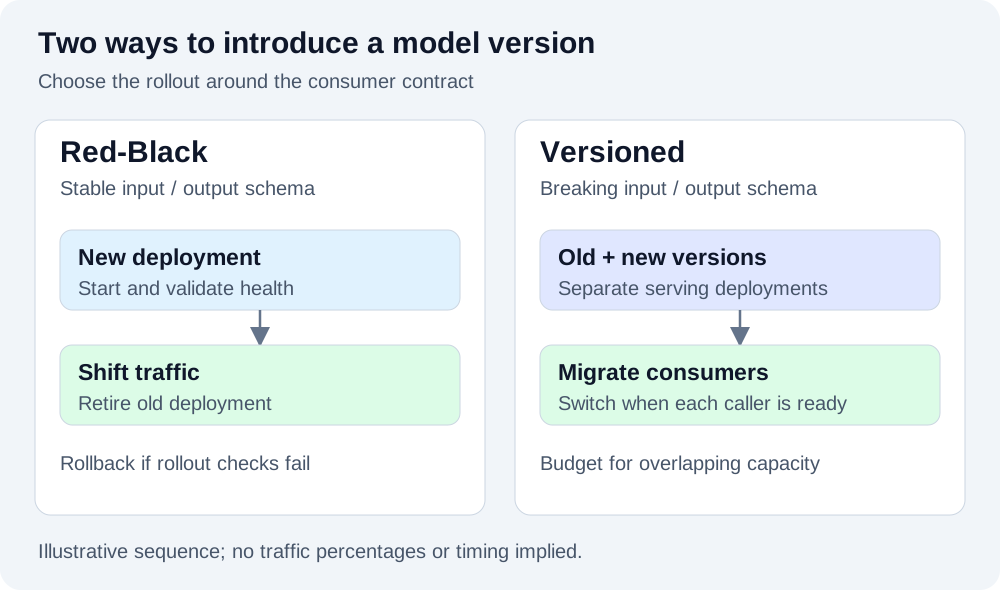
Figure 2. Simplified rollout choices from Netflix’s account. The sequence is illustrative; no timing or traffic percentages are implied.
Imagine an output changing from a single score to a list of candidates with explanations. A new model could pass its own health checks while an older caller still expects one number. In this hypothetical migration, deployment readiness and consumer readiness are separate milestones.
I would make the migration plan explicit: identify affected callers, define their switching condition, preserve a rollback path, and decide what evidence permits retiring the old version. That plan also gives capacity planning a concrete overlap period to consider.
6. Constrained Decoding Adds State to Generation
Netflix moved constraint processing from sequential Python work to batched, multithreaded C++ with vLLM V1. Preemption also required reconciling constraint state with shortened token histories. Source: Netflix.
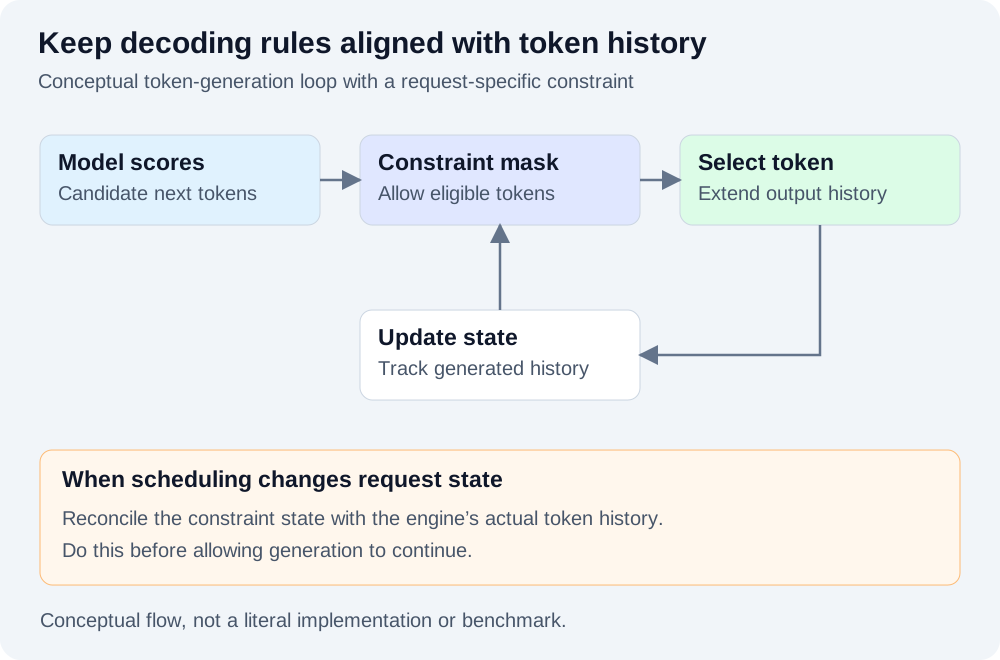
Figure 3. Conceptual illustration of stateful token constraints, informed by Netflix’s decoding discussion. This is not a literal implementation diagram.
The engineering implication is that custom generation logic needs a clearly stated relationship with engine state. If that relationship depends on the output history always growing, interruptions deserve explicit attention during testing.
I would exercise a mix of short and long requests, frequent batch membership changes, and resource pressure. The goal would be to check both output validity and recovery behavior. A successful isolated request provides little evidence about those interactions.
7. Observe the Request at Several Levels
vLLM documents metrics for waiting and running requests, time to first token, inter-token latency, end-to-end latency, KV cache usage, and preemptions. These give several views of serving behavior beyond a single response-time average. Source: vLLM production metrics.
The following is a proposed investigation guide, not Netflix’s dashboard layout:
| Observation | What I would investigate next |
|---|---|
| Slow first token | Queue time, prompt length, and work before generation starts |
| Long pauses during output | Decode-step timing and custom processing overhead |
| Growing waiting queue | Arrival rate, available capacity, and admission policy |
| Rising cache pressure and preemptions | Request lengths, concurrency, and memory allocation |
| Valid JSON with poor predictions | Evaluation data, prompts, and model quality |
A useful load test would vary input length, output length, concurrency, and constraints independently. That makes it easier to see which workload dimension causes a regression. I would report latency distributions alongside throughput and the rate of contract-valid responses.
Questions to Bring to a Platform Review
The case study leaves me with four practical questions:
- Can we reproduce a deployment from its complete release record?
- Do our API checks verify the behavior of the full request path?
- Can consumers migrate safely when the model’s contract changes?
- Does custom decoding remain correct when scheduling interrupts a request?
These questions turn the architecture discussion into concrete review work: identify the owner, define the expected behavior, and gather evidence at each boundary.