Reading notes from 2017; technical explanations revised November 17, 2026. Architecture and scale observations refer to the source period.
Put checks where failures can be acted on
The source talk provides a historical overview of Netflix’s data platform. A platform diagram explains component placement, but a data-quality design also needs a rule, an owner, and an action when the rule fails.
Consider an illustrative daily playback dataset. A schema check could reject an unexpected field type. A freshness check could detect that a partition has not arrived. A distribution check could flag a sudden change in a key metric. Those checks answer different questions and should not all produce the same response.
Stop or quarantine deliberately
A malformed input might be quarantined while healthy inputs continue. A missing critical partition might block publication of a report. A distribution alert might require investigation before retraining a model. These are example policies, not claims that the talk describes those exact rules.
Store the dataset version and rule result so the incident can be reproduced. Ownership matters: a dashboard alert without a responsible producer or consumer often leaves the problem unresolved.
For follow-up reading, compare the online/offline contract in Chronon with the model-serving contract in Netflix LLM serving.
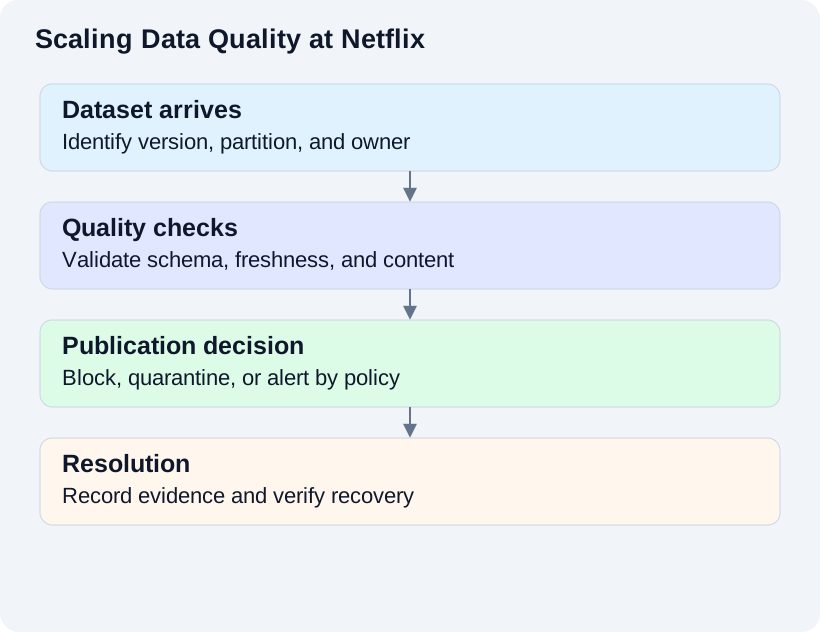
Conceptual illustration; labels describe responsibilities, not a deployment specification.

Source Netflix data-platform overview; validation policy needs an owner at each boundary. Historical source figure; attribution and context are in References.