The first useful incident assistant may be the one that reconstructs what happened. During an outage, engineers need a shared timeline, recent changes, customer impact, and plausible explanations before they need another automated remediation command.
In the InfoQ DevOps modernization panel, Mallika Rao emphasizes reducing ambiguity and starting with summarization and correlation. Patrick Debois distinguishes contextual explanation from time-series prediction, while Olalekan Elesin stresses tracing fundamentals. That combination suggests a practical boundary: use the model to organize evidence, and keep evidence collection and action authorization explicit.
Build a timeline with references
Imagine a checkout service whose error rate rises shortly after a deployment. A useful incident record would include the deployment identifier, affected routes, trace samples, metric windows, and relevant configuration changes. Each statement should link to an observation with a timestamp.
The model can group observations, identify missing information, and draft a concise narrative. It should preserve uncertainty. A deployment preceding an error spike is a candidate explanation; temporal proximity alone does not establish causation.
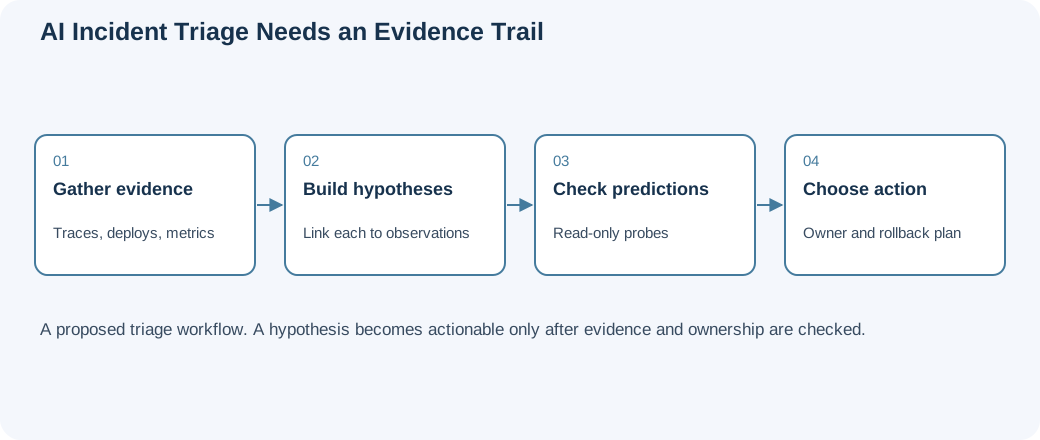
A proposed triage workflow. A hypothesis becomes actionable only after evidence and ownership are checked.
Ask hypotheses to make predictions
Suppose the assistant proposes connection-pool exhaustion. Ask what should be observable if that explanation is correct: high pool wait time, blocked request threads, or connection acquisition failures. Compare those predictions with the actual measurements.
| Hypothesis | Evidence to seek | Evidence that would weaken it |
|---|---|---|
| Bad rollout | Errors concentrated on new revision | Similar failure on old revision |
| Downstream slowdown | Longer dependency spans | Dependency timings remain normal |
| Traffic shift | Changed route or tenant mix | Stable workload composition |
These are investigation prompts for the hypothetical checkout service, rather than a universal diagnosis table. An assistant should be able to say that the necessary measurement is absent.
Keep remediation a separate decision
Read-only diagnosis and production mutation need different privileges. A rollback proposal should name the revision, affected environment, expected benefit, and a way to detect that the rollback made things worse. Existing incident command and change policies still apply.
For an initial rollout, I would replay historical incidents with information restricted to what was available at each moment. Measure time to an evidence-backed hypothesis, unsupported claims, and engineer corrections. Do not score an assistant using a postmortem answer that it could not have known during the incident.
The useful output is a smaller, better-supported decision space for the on-call engineer, with enough provenance to challenge the model’s interpretation.
Related reading: Staff engineers and incidents.
Archive note: added November 18, 2026, and filed under 2026-03 as part of the systems reading series.