Sizing every executor for the largest task wastes memory when only a small tail needs it. Sizing for the typical task lowers cost but exposes the job to out-of-memory failures. Pinterest’s approach makes that tradeoff a scheduler responsibility.
The Pinterest engineering article, covered by InfoQ, describes Auto Memory Retries: tasks identified as having failed from memory exhaustion can be retried on larger executors. This is more specific than restarting an entire job with more memory. Pinterest reports a 96% reduction in OOM failures in its rollout; that result belongs to its workload and platform.
Separate task demand from executor capacity
Consider a hypothetical stage where most tasks need modest memory and a few process much larger partitions. A larger executor can recover some of those tail tasks without reserving that capacity for the whole stage.
Executor memory is shared across concurrent tasks, however. Dividing configured memory by task slots is an intuition, not a hard per-task allocation guarantee. Changing executor cores can change aggregate pressure even when the per-executor memory setting stays fixed.
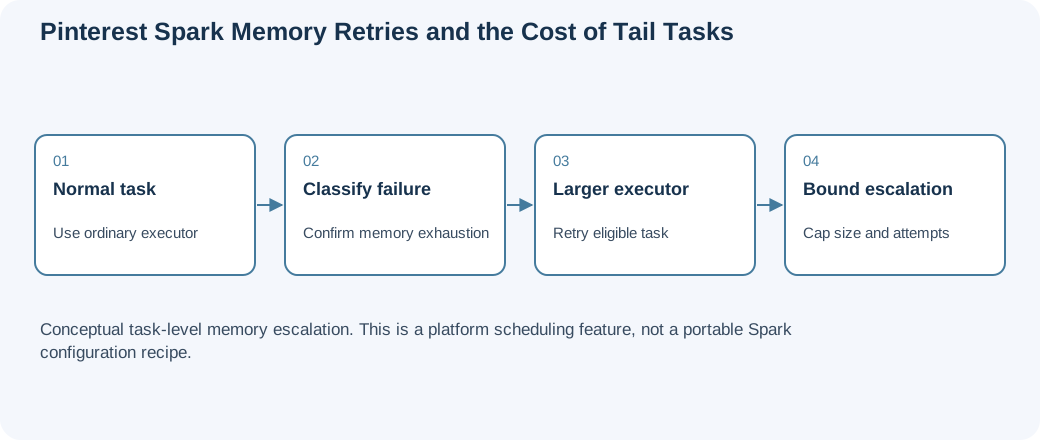
Conceptual task-level memory escalation. This is a platform scheduling feature, not a portable Spark configuration recipe.
A retry policy needs a classifier
A lost executor is not automatically evidence of Java heap exhaustion. Container limits, native memory, machine failures, and application exceptions call for different responses. A platform should retain exit reasons, task attempts, memory observations, and the resource profile used by each attempt.
A proposed policy might escalate only recognized memory failures, cap the number and size of escalations, and record why the retry was eligible. Persistent skew or an unbounded aggregation can still exceed the largest allowed executor. Escalation is a recovery mechanism, not a proof that the query is healthy.
| Observation | Next engineering question |
|---|---|
| One task repeatedly fails | Is one key or partition disproportionately large? |
| Many tasks fail together | Is executor concurrency too high for available memory? |
| Failure survives escalation | Is the algorithm’s working set unbounded? |
| Queue time grows | Is the larger resource pool too small? |
Count recovered work and extra cost
A useful evaluation compares final job completion, retry count, resource-seconds, queue delay, and downstream freshness. Fewer visible failures can conceal longer recovery or a growing expensive-executor pool.
I would first exercise a memory-heavy workload with repeatable skew, then a case that should fail without escalation. The operational win is recovering the eligible tail at bounded cost while making structural problems easier to identify.
Related reading: Spark memory model.
Archive note: added November 18, 2026, and filed under 2026-04 as part of the systems reading series.