A tool protocol solves the shape of a call. A production platform also has to decide who owns the tool, who may discover it, what identity reaches the backend, and how access is revoked.
The Pinterest MCP case study, reported by InfoQ, is useful because it treats those surrounding concerns as infrastructure. Pinterest describes multiple domain-specific servers, a central registry, and integration into employee-facing surfaces. Its engineering account distinguishes end-user JWT authorization from service-mesh identity and applies finer-grained policy inside servers.
Discovery is not authorization
Consider a hypothetical SQL diagnostics tool listed in an internal registry. Knowing that the tool exists should not grant permission to query every database. A caller may have access to the server but lack access to a particular dataset or operation.
The request needs a verifiable identity and an authorization decision at the point where the protected operation occurs. If a proxy supplies identity headers, the backend must accept them only through a trusted path; arbitrary client-supplied headers cannot become proof of group membership.
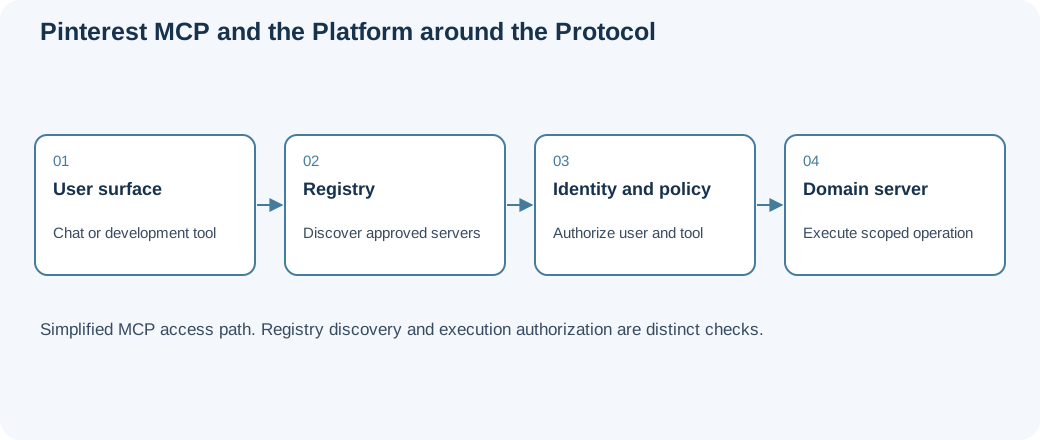
Simplified MCP access path. Registry discovery and execution authorization are distinct checks.
Define the smallest useful operation
A generic shell or unrestricted SQL tool offers broad flexibility but makes policy and auditing harder. A narrower operation such as fetching one job’s execution diagnostics has a clearer resource scope and a more predictable response size.
For a proposed internal platform, I would require each tool to declare an owning team, operation type, resource scope, timeout, output limit, and audit fields. A read operation can still expose sensitive information, so read-only status does not remove the need for data authorization.
| Boundary | Example question |
|---|---|
| Registry | Is this server approved and owned? |
| Connection | May this user establish a session? |
| Tool invocation | May this user perform this operation now? |
| Data system | Which rows or resources may be accessed? |
Revocation and observation close the loop
Cached tool lists and long-lived sessions complicate access changes. Specify when permission changes take effect and test removal of a user’s group membership during a session. Backend checks need to remain authoritative even if a client still displays an old tool.
Record operation identifiers, authorization outcomes, duration, and sanitized error categories. Raw prompts and tool results may contain protected data, so telemetry needs its own access and retention policy.
The design question I would take into a review is simple: if the model requests the wrong operation with perfectly valid protocol syntax, which component prevents the effect?
Related reading: AgentCore platform boundaries.
Archive note: added November 18, 2026, and filed under 2026-04 as part of the systems reading series.