“Why did European revenue fall?” asks for both a measurement and an explanation. A document retriever may find market commentary without establishing the revenue change. A SQL query may calculate the change without explaining it.
Abhijit Ubale’s hierarchical agentic RAG article explores a supervisor-worker architecture spanning structured queries and document retrieval, with explicit state and error recovery. The interesting part is the evidence boundary between specialists. Adding more agents is useful only if their outputs can be checked and combined correctly.
Define what each specialist returns
For a hypothetical revenue investigation, the SQL specialist should return the query, schema version, period, currency, dimensions, and result rows. The document specialist should return source identifiers, publication dates, relevant passages, and access scope.
A supervisor can then ask whether both branches discuss the same region and time period. Comparing a quarterly database aggregate with a monthly market report without acknowledging the mismatch can produce a fluent but invalid explanation.
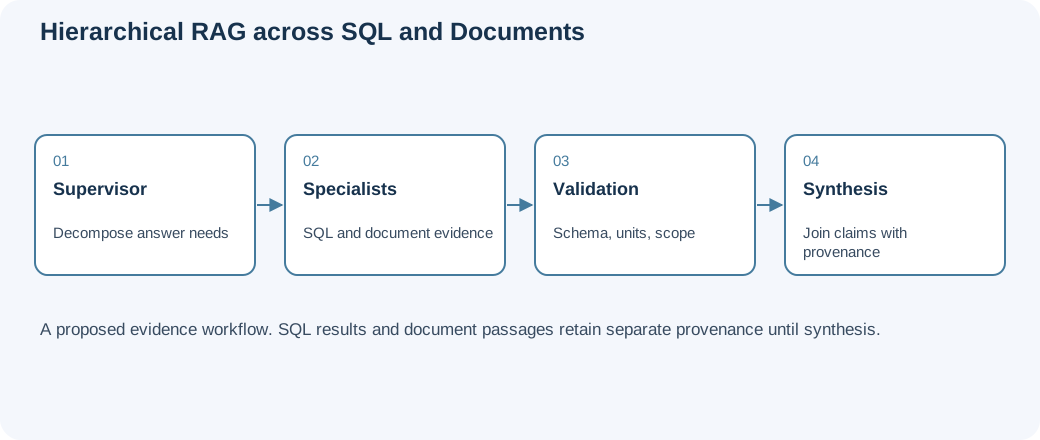
A proposed evidence workflow. SQL results and document passages retain separate provenance until synthesis.
Repair execution errors without inventing evidence
A SQL syntax failure is different from an empty valid result. A bounded repair loop can use database error feedback to correct syntax, but it must not keep relaxing filters until a desired number appears.
For a proposed implementation, use a read-only database role, allowed datasets, statement and row limits, and a query timeout. Those controls belong in the execution layer. A model instruction to “only run safe SQL” does not enforce them.
| Worker outcome | Supervisor response |
|---|---|
| Invalid query | Attempt a bounded, recorded repair |
| Empty valid result | Preserve the absence of data |
| Scope mismatch | Reconcile periods or ask for clarification |
| Missing explanatory evidence | Return measurements with uncertainty |
Synthesis should preserve the join
The final answer needs to distinguish a measured fact from a plausible explanation. A fall in revenue and a document describing supply disruption may be consistent, but do not alone establish causation.
I would retain a claim-to-evidence map through synthesis, then evaluate numerical correctness, evidence coverage, and unsupported causal language separately. A single overall answer score makes it difficult to tell whether retrieval, SQL, coordination, or generation failed.
A useful baseline is one orchestrator with two deterministic tools. Introduce specialist agents only when their independent reasoning improves a measured task outcome enough to justify more latency, tokens, and failure paths.
Related reading: Context-aware retrieval.
Archive note: added November 18, 2026, and filed under 2026-05 as part of the systems reading series.