A repository issue is both useful task context and untrusted input. An agent that can read issues and write repository state needs a security boundary that holds even when the issue text influences its behavior.
GitHub’s security architecture account, also covered by InfoQ, describes isolated components, credentials mediated outside the agent, and staged writes through safe outputs. Proposed updates pass through operation, volume, and content checks. This is an architecture for constraining effects; it does not make an agent’s reasoning inherently trustworthy.
Separate proposal from capability
Imagine an agent asked to summarize failing tests and open an issue. It needs logs and read access to the relevant code. It does not necessarily need a token that can push arbitrary commits or modify repository settings.
A proposed write should be a structured artifact: operation type, destination, body, and references to the triggering task. A trusted component can evaluate that artifact using a narrower credential. The agent cannot bypass the gate by choosing a different API client if its execution environment lacks that capability.
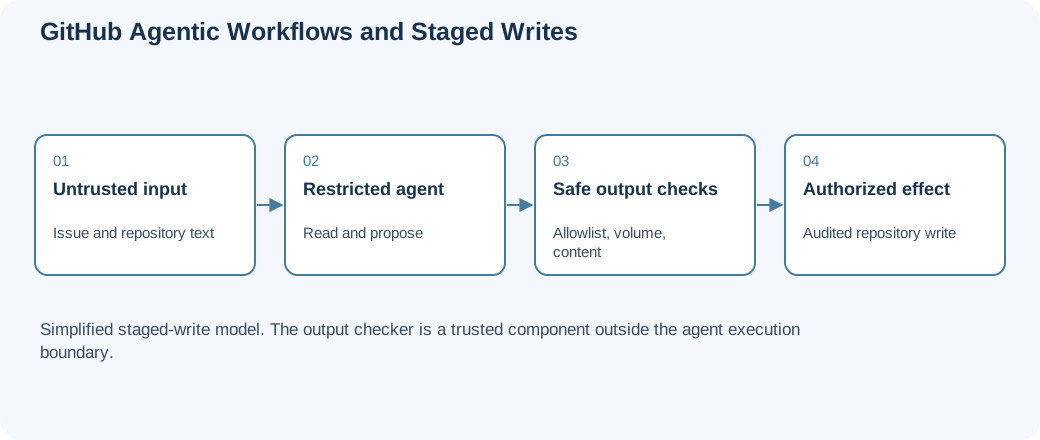
Simplified staged-write model. The output checker is a trusted component outside the agent execution boundary.
Validate the effect as well as the text
Removing suspicious strings is insufficient when the operation itself is wrong. A perfectly ordinary issue comment can still target the wrong repository or disclose private information into a public thread.
| Check | Example policy for the hypothetical summarizer |
|---|---|
| Operation | May create an issue, not change settings |
| Destination | Restricted to the originating repository |
| Volume | Bounded number of writes per run |
| Visibility | Private log content cannot become public output |
| Content | Remove credentials and reject invalid fields |
Human review may be appropriate for some outputs, while other bounded outputs can follow established automation policy. Staged writes and human approval are related controls, but are not synonymous.
Treat logs as another protected output
A complete trace helps reconstruct tool calls and authorization decisions. It can also retain repository content, personal data, or secrets. Apply access controls and retention limits to those traces, and avoid assuming that exhaustive raw logging is harmless.
For a proposed evaluation, place hostile instructions inside a test issue, attempt an unauthorized destination, and submit too many otherwise valid updates. Verify rejected effects at the trusted boundary. A model refusing the instruction in one run is weaker evidence than an enforced capability restriction.
Related reading: Architecture patterns for agentic applications.
Archive note: added November 18, 2026, and filed under 2026-06 as part of the systems reading series.