A hot account cannot always be scaled by adding consumers. If every update changes the same balance, more workers may create more contention on the same record.
Uber’s payment account processing article, covered by InfoQ, describes grouping account updates into short batches, coordinating through Redis, and using optimistic atomic updates. The reported design uses an approximately 250-millisecond window and supports more than 30 updates per second per account. These are case-study results, not general limits for ledgers or databases.
Amortize the serialized section
In a hypothetical ledger, each update reads an account version, validates an operation, writes a new state, and appends an audit record. A batch can share some of that storage work across several operations while preserving their individual meanings.
A batch of eight updates does not mean one anonymous net change. If an auditor needs to explain a balance, the system must retain the original operation identifiers and accepted or rejected outcomes. Netting values without provenance would erase the business history.
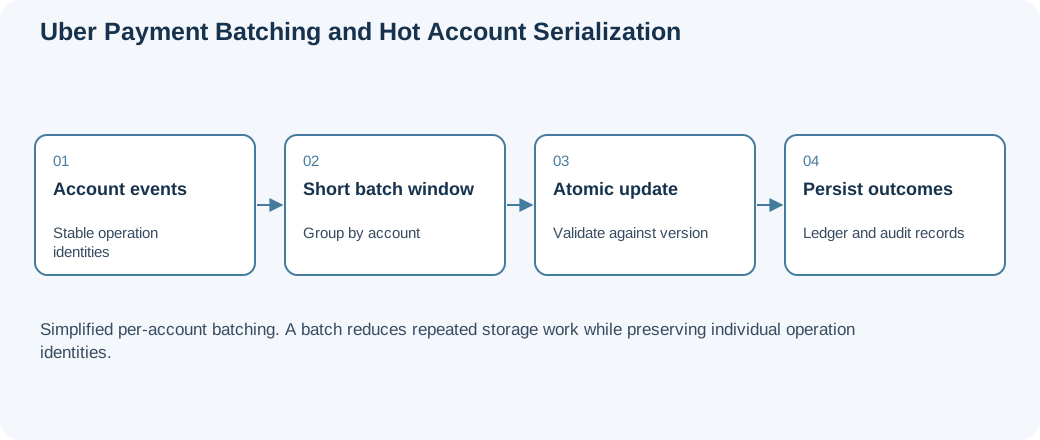
Simplified per-account batching. A batch reduces repeated storage work while preserving individual operation identities.
Ordering is part of correctness
Imagine a balance of 100, a debit of 120, and a credit of 50. Applying the credit first can admit the debit; applying the debit first may reject it. The same arithmetic net change therefore does not imply the same valid operation sequence.
A proposed system needs an ordering rule, a rule for individual validation failures, and a documented visibility point for readers. An optimistic version conflict should cause a retry against fresh state rather than overwriting another writer’s result.
| Boundary | Question |
|---|---|
| Batch membership | Which events belong to this attempt? |
| Ordering | In what sequence are business rules evaluated? |
| Commit | Which state and audit records become durable together? |
| Retry | How are already committed operations recognized? |
Throughput buys waiting time
With a fixed window of width W and uniformly distributed arrivals, an operation waits about W/2 on average just for the batch to close. A 250-millisecond window therefore contributes about 125 milliseconds under that simplified assumption, before queueing and execution.
I would compare windows using account-level tail latency, conflict rate, storage work per operation, and backlog age. Also test a crash after commit but before acknowledgment. The recovered worker must preserve operation identity rather than apply the batch again as new business activity.
The attractive optimization is reducing repeated work at a necessary serialization point while keeping the ledger’s semantics visible.
Related reading: Idempotent retries and unknown outcomes.
Archive note: added November 18, 2026, and filed under 2026-07 as part of the systems reading series.