A candidate in one hiring system may be a global profile; in another, the candidate may exist only within a job application. Renaming fields cannot reconcile that difference. The integration must preserve what the records mean.
LinkedIn’s unified integrations account, highlighted by InfoQ, describes partner adapters, a canonical entity model, Temporal-based orchestration, Kafka change signals, and raw record persistence in Espresso. It emphasizes coexistence with partner systems and differing identity and lifecycle semantics. The platform work is foundational to downstream AI features, not merely plumbing around them.
Model identity before mapping fields
Consider a hypothetical partner that reuses application identifiers across jobs. A target key based only on application ID can merge unrelated records. A mapping may need tenant, source system, job, entity type, and source identifier.
Store the source identity separately from the canonical identity. That supports reconciliation when a partner changes its identifiers or an entity splits into several target records. Preserve enough provenance to explain a transformation without keeping unnecessary personal data indefinitely.
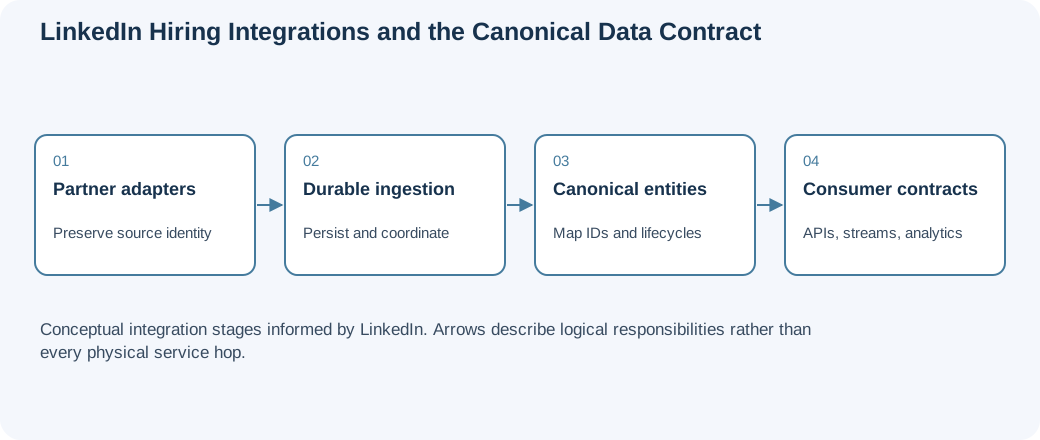
Conceptual integration stages informed by LinkedIn. Arrows describe logical responsibilities rather than every physical service hop.
Bootstrap and incremental sync share a contract
Initial imports can overlap live changes. If a bootstrap record arrives after a newer webhook, arrival order alone is unsafe. Prefer source versions or sequence information where available, and explicitly define reconciliation behavior when they are absent.
A replayable pipeline also needs deletion semantics. Does a missing record mean deleted, temporarily unavailable, or omitted from a paginated response? Treating those cases as identical can either lose data or resurrect it.
| Integration concern | Contract to define |
|---|---|
| Identifier scope | What uniquely names a source entity? |
| Update order | How are stale versions detected? |
| Partial payload | Does absence clear a field or preserve it? |
| Deletion | How is removal represented and propagated? |
| Retry | How is the same source change recognized? |
Evolve mappings without silent changes
For a proposed integration, retain mapping versions and test recorded, sanitized partner fixtures before rollout. A replay using a new mapping should have an explicit purpose and a way to compare outcomes with the previous version.
I would measure convergence delay, reconciliation differences, duplicate identities, and rejected transformations alongside ingestion throughput. A fast pipeline that quietly maps the wrong person to the wrong application is not a healthy data platform.
Related reading: LinkedIn AI data platform.
Archive note: added November 18, 2026, and filed under 2026-06 as part of the systems reading series.