A media pipeline has to preserve creative intent while handling varied cameras, file formats, and downstream workflows. Elastic compute is useful only if repeating a job produces an explainable, compatible result.
Netflix’s Scaling Camera File Processing, covered by InfoQ, describes the Media Production Suite and collaboration with FilmLight. FilmLight supplies specialized image-processing capabilities while Netflix integrates them into cloud production workflows. That division is a useful example of keeping domain expertise behind a scalable orchestration boundary.
Treat the recipe as part of the asset
For a hypothetical transcoding service, a job identity should include more than the source filename. It can include the immutable input version, processing-engine version, color-transform configuration, and output profile. A filename reused for a replacement upload should not accidentally reuse an older result.
A worker’s successful exit is only one check. The expected outputs need to exist, match the declared format and duration constraints, and carry the metadata required by consumers. Some forms of image correctness still need domain-specific validation or human review.
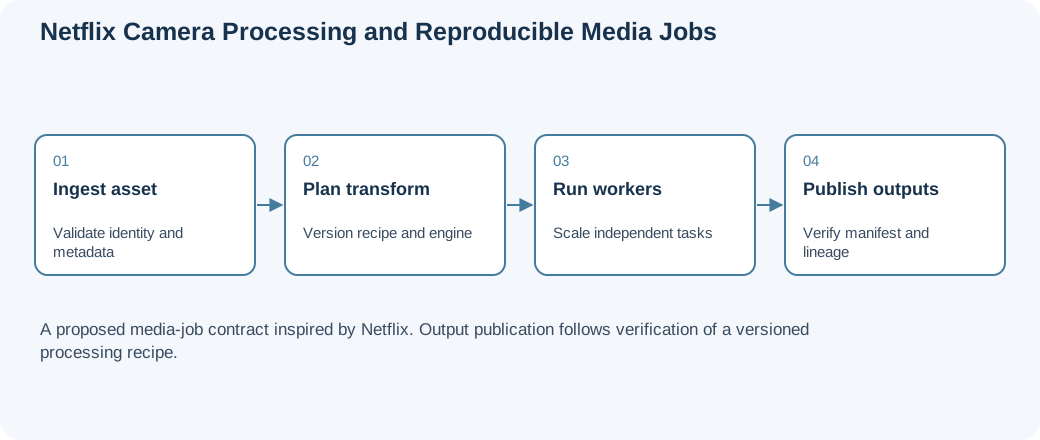
A proposed media-job contract inspired by Netflix. Output publication follows verification of a versioned processing recipe.
Publish complete output sets
Suppose a job emits several proxies, thumbnails, and metadata files. A consumer observing only half the set can begin downstream work with an incomplete asset. A proposed pattern writes outputs to a job-specific location, verifies them, then publishes a manifest that identifies the completed set.
That manifest becomes the consumer’s readiness signal. A retried worker can recognize an already published job or replace only its own unpublished attempt, without overwriting a different recipe’s outputs.
| Record | What it explains |
|---|---|
| Input version | Which bytes were processed |
| Recipe version | Which transforms were requested |
| Engine identity | Which implementation performed them |
| Output manifest | Which artifacts belong to the result |
| Validation results | Why the result was accepted |
Scale around data movement
More workers may not reduce turnaround if the bottleneck is reading large source files, moving outputs, or loading processing dependencies. Separate queue time, input transfer, transform execution, output transfer, and validation in telemetry.
I would test a worker interruption during output upload, duplicate job submission, and a recipe upgrade against known reference material. The goal is reliable asset lineage and recovery as well as throughput. Once those contracts are explicit, scaling the worker fleet becomes a more tractable infrastructure problem.
Related reading: Scheduling shared processing capacity.
Archive note: added November 18, 2026, and filed under 2026-10 as part of the systems reading series.