An incident query often contains both a concept and an exact identifier: “rollback procedure for payments-v3.2.” A semantically related document for another release may be plausible yet operationally wrong.
The InfoQ article Why Vector Search Alone Isn’t Enough examines that precision problem and combines lexical and vector retrieval. The useful distinction is between conceptual similarity and exact entity identity. Neither retrieval method should be assumed to solve every query class.
Combine candidates before generation
A hypothetical support search service can retrieve lexical matches and embedding neighbors independently, then merge their candidate lists. Before retrieval, apply the same tenant, permission, product, and document-status constraints to both branches.
Do not pass unauthorized candidates to a later reranker and hope they disappear. Similarly, deduplicate overlapping chunks so a single source does not occupy most of the evidence budget simply because it appeared through two retrieval routes.
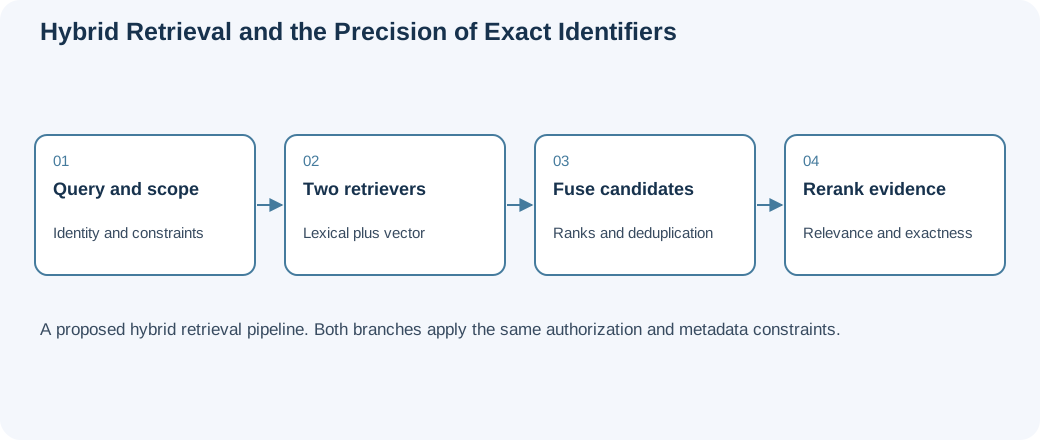
A proposed hybrid retrieval pipeline. Both branches apply the same authorization and metadata constraints.
Fuse ranks when scores have different meanings
A lexical score and a vector similarity score generally do not share a natural scale. Adding them directly gives their numerical ranges an accidental influence. An alternative is reciprocal rank fusion: give a document a contribution of 1/(k+r) from each list in which it appears, where r is its one-based rank and k is a positive smoothing constant.
For illustration, with k=60, a document at ranks 1 and 3 scores 1/61 + 1/63, approximately 0.03227. A document appearing only at rank 1 scores about 0.01639. This calculation explains the rule, not an optimal setting for a production corpus.
Fusion does not enforce a requested release version. If a version is a hard requirement, represent it as a filter or an explicit validation rule rather than relying on its influence on relevance ranking.
Evaluate by query type
| Query class | Failure worth measuring |
|---|---|
| Exact error or version | Correct identifier absent from top results |
| Conceptual question | Relevant document uses different wording |
| Mixed query | Correct concept, wrong product or version |
| No supported answer | Confident evidence selected from an unrelated source |
I would build labeled examples for each class and compare lexical-only, vector-only, and fused retrieval at a fixed evidence budget. Measure retrieval relevance separately from answer quality; a strong generator can conceal a weak retriever on easy questions.
The objective is to make the right evidence available with its identifiers intact. More candidates help only if the final context remains relevant, authorized, and small enough to use.
Related reading: Haystack retrieval examples.
Archive note: added November 18, 2026, and filed under 2026-10 as part of the systems reading series.