Reading notes from 2024; revised November 17, 2026. Reported architecture and scale refer to the source period.
Three subsystems one model lifecycle
The Griffin v2 account describes training infrastructure, a model-service platform, and a feature store. Ray is part of the training story. The architecture should be understood around what practitioners hand from one subsystem to another, rather than as a collection of interchangeable tools.
Follow a candidate model
In a conceptual workflow, a developer fixes a dataset and feature definition, runs training, records evaluation, and publishes a model artifact. Serving then needs a compatible input/output schema and a rollout plan. The feature store supports the data contract consumed on both training and prediction paths.
A successful training run does not establish serving readiness. The artifact may exceed a latency or memory budget; the expected feature may be unavailable online. Evaluate those constraints before promotion.
Compare platform generations carefully
The original announcement is the reference for the actual v1 limitations and v2 capabilities. The transferable question is which handoff became easier or more reproducible. A new distributed runtime is useful when it addresses a measured workload or developer-experience constraint.
| Platform review | Evidence to request |
|---|---|
| Training | Reproducible configuration, resource use, and artifacts |
| Features | Definition versions, freshness, and missing-data behavior |
| Serving | Schema checks, deployment isolation, and rollback |
| Adoption | Ownership and debugging paths for model authors |
Related platforms: Michelangelo, Cloudflare, and Netflix LLM serving.
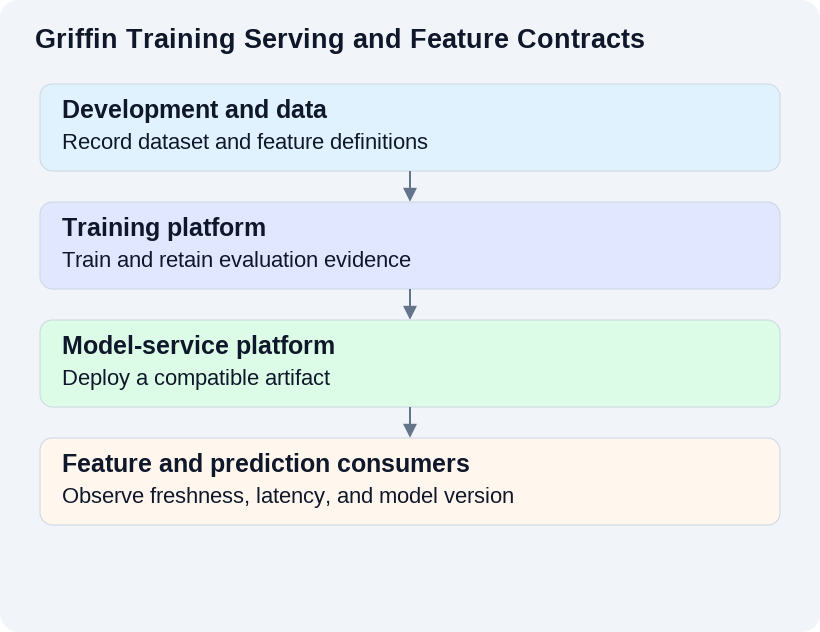
Conceptual illustration; labels describe responsibilities, not a deployment specification.

Instacart source architecture separates training, model services, and features. Historical source figure; attribution and context are in References.