Deleting a row is a local storage operation. Deleting an entity across a platform is a distributed workflow involving discovery, eligibility, execution, and evidence that the intended copies were addressed.
The Netflix presentation Architecting a Centralized Platform for Data Deletion discusses storage-specific deletion behavior, paced work, and continuous audit. A tombstone, a cache removal, and an object-store delete have different operational consequences. Central coordination is useful because policy and progress need a common view even when execution stays specific to each datastore.
Define what completion means
For a hypothetical customer-data platform, distinguish “request accepted,” “logical reads no longer return the data,” and “physical reclamation completed.” Those milestones can occur at different times. Backup retention and legal holds introduce additional policy conditions that must be explicit.
A deletion record can track the entity scope, policy version, eligible targets, completed steps, exceptions, and verification results. Keep that record minimal: an audit system that unnecessarily reproduces deleted personal data creates another copy to manage.
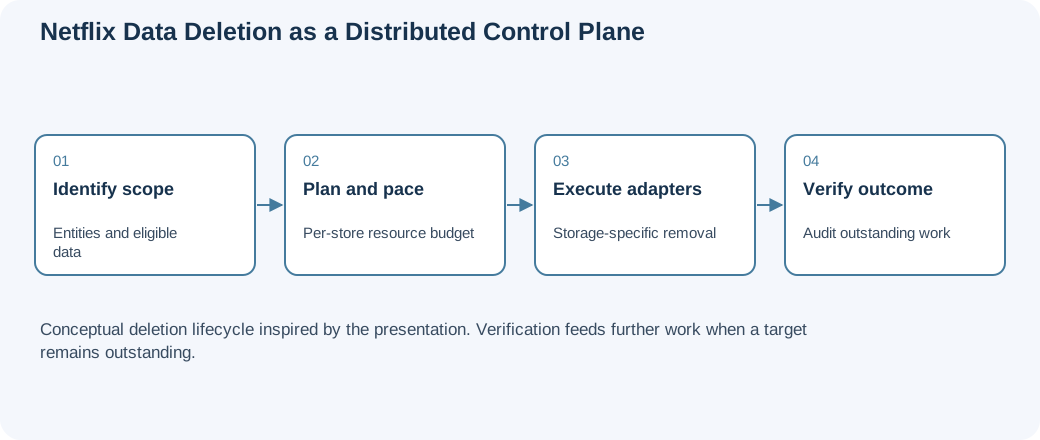
Conceptual deletion lifecycle inspired by the presentation. Verification feeds further work when a target remains outstanding.
Deletion competes with production traffic
Large synchronized expiration waves can create write, compaction, and storage pressure. A proposed controller should pace work using per-store budgets and observed resource conditions. Spreading eligible work over time can smooth demand where the policy permits it.
| Target | Important distinction |
|---|---|
| Database | Logical deletion may precede physical reclamation |
| Search index | Refresh and merge behavior affect visibility and storage |
| Cache | Eviction does not remove the authoritative source |
| Derived dataset | Source deletion needs propagation to derived copies |
Do not assume a successful adapter response proves the whole request is complete. A stale index or a forgotten derived table can remain outside the original execution path.
Prevent resurrection during replay
Suppose a delayed ingestion event arrives after deletion. If the ingest pipeline treats it as a new entity update, removed data can return. A proposed design needs a deletion marker, entity generation, or another policy-aware check that survives the relevant replay horizon.
Verification should examine representative read paths and reconcile the target inventory against recorded outcomes. Also test duplicate requests, adapter outages, and a newly registered dataset joining after a deletion request was created.
The key architectural question is who owns the unresolved tail. A central platform is valuable when it makes incomplete deletion discoverable and recoverable, rather than merely sending delete commands faster.
Related reading: Scaling data quality at Netflix.
Archive note: added November 18, 2026, and filed under 2026-09 as part of the systems reading series.